Project News

Over 45 representatives from the DigiCare4You consortium and its International Stakeholder Advisory Board, including experts from National Ministries of Health and Education, WHO Europe, pan-European public health organisations, national diabetes associations and implementing partners, gathered in Lisbon, Portugal for the project’s first Capacity Building and Recommendations Development (CBRD) workshop. 

Learn more in our video here

  1. Could you please introduce yourself and your role in DigiCare4You?

My name is Delfien Gryspeerdt, I am a PhD researcher in health economics at Ghent University in Belgium. While other partners in DigiCare4You focus on the project implementation, clinical effectiveness and scalability, our team brings a health economic perspective to answer a crucial question: is DigiCare4You a smart investment for national healthcare systems?

Over 45 representativesfrom the DigiCare4You consortium and its International Stakeholder Advisory Board, including experts from National Ministries of Health and Education, WHO Europe, pan-European public health organisations, national diabetes associations and implementing partners, gathered in Lisbon, Portugal for the project’s first Capacity Building and Recommendations Development (CBRD) workshop.

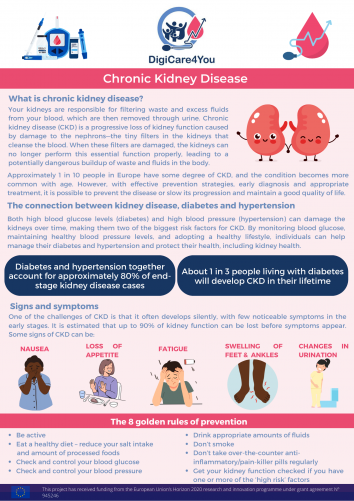
Diabetes and hypertension together account for 80% of end-stage kidney diseases cases making them two of the biggest risk factors for chronic kidney disease (CKD).

This is because both high blood glucose levels and high blood pressure can damage the kidneys over time. By monitoring blood glucose, maintaining healthy blood pressure levels and adopting a healthy lifestyle, individuals can help manage their diabetes and hypertension and protect their kidney health.

What is obesity?

In 2022, over 890 million adults, representing 16% of adults worldwide, were living with obesity. The World Health Organization (WHO) defines obesity as a complex chronic disease characterised by excessive body fat that can harm health. Body mass index (BMI) and waist circumference measurements are commonly used tools for diagnosing obesity. However, while diagnosing obesity may be straightforward, its causes are often misunderstood and framed as solely personal lifestyle choices. In reality, obesity is influenced by many factors beyond individual behaviour, including genetic, environmental and societal determinants.

Representatives from the 16 international, multidisciplinary DigiCare4You consortium partners gathered in Sofia, Bulgaria on December 16-18 2024, for the project’s sixth consortium meeting. DigiCare4You partners reviewed the progress made in each work package since the previous consortium meeting in May 2024 and discussed next steps for the project.

Read the full press release here.  

Pages

Subscribe to Project News